The Best Customer Feedback Tools for SaaS Teams in 2026


Customer feedback tools capture different kinds of evidence. Productlane fits software companies that want feedback beside autonomous AI support. Its agent uses codebase-derived product knowledge to answer questions, while genuine product requests remain connected to engineering.
The five kinds of feedback tools
A feedback board groups requests and votes. A survey asks structured questions. An in-app widget captures a message while the customer uses the product. Analytics and session replay show behavior. Review sites collect public opinions. These tools can complement one another; they are not interchangeable.
Begin with the signal you need. If a customer cannot find an existing setting, an accurate support answer may solve the problem. If the product lacks the capability, record the request with its context. If many people abandon a page silently, behavior analysis may reveal what a support inbox never sees.
Customer feedback tools compared
| Tool | Best fit | Pricing and AI billing |
|---|---|---|
| Productlane | Autonomous AI resolutions for software companies, especially B2B | From $29/user/month, billed yearly. AI: $0.79 per resolution beyond the plan allowance. |
| Canny | Dedicated feedback collection and prioritization | Free for 25 tracked users. Pro from $79/month, billed yearly; scales with tracked users. |
| Featurebase | Combined helpdesk and product feedback | Free plan; Growth $29/seat/month, billed yearly. Fibi $0.49/AI resolution. |
| Pylon | B2B account support across shared channels | Request a quote covering seats, AI usage, and required modules. |
| Typeform | Structured surveys and forms | Basic displayed at $28/month on annual billing, or $39 monthly, for 100 responses/month. |
| Sprig | Research programs and in-product surveys | Custom pricing based on response volume and activated capabilities. |
| Hotjar | Behavioral feedback and session analysis | Check current Contentsquare packaging and usage limits. |
| PostHog | Product analytics and session replay | Free allowances followed by product-specific usage pricing. |
| G2 | Public customer reviews | Review monitoring is a separate job from support resolution. See vendor services. |
Canny provides dedicated feedback collection with automated capture. Featurebase bundles feedback and helpdesk. Pylon is relevant when feedback originates in B2B support conversations. Typeform collects structured answers, while Sprig offers a broader research platform. Hotjar's current offering is part of Contentsquare, so check current packaging rather than an old standalone price. PostHog provides usage-priced analytics products. G2 serves a separate role as a public review site.
Autonomous resolutions for software companies
Productlane focuses on resolving software support questions autonomously, with a particular focus on B2B. The Productlane Agent learns how your product works from your connected codebase. That gives it product knowledge for questions about settings, permissions, or behavior that a short help article may leave unanswered.
Product knowledge from your codebase
Through the GitHub connection, Productlane reads the repository you select to create reference articles for the agent. These describe the product your customers use. They stay outside the public help center, while articles marked internal remain excluded from the customer agent's knowledge. The agent uses this product knowledge to explain what a customer should do.
Your team controls what knowledge the agent can use. Review generated articles before relying on them for sensitive workflows. Connecting a repository supplies product context; it does not give customers repository access.
Measure completed resolutions
Evaluate the agent on your own software questions, with one resolution definition, your real ticket mix, and a fixed observation period.
When a question needs an engineering change, the agent can file a Linear issue with the conversation attached. Productlane prepares a customer follow-up when the linked work ships. That engineering workflow supports the main goal: more customer questions resolved autonomously.
See the Productlane Agent or how to evaluate an AI support agent.
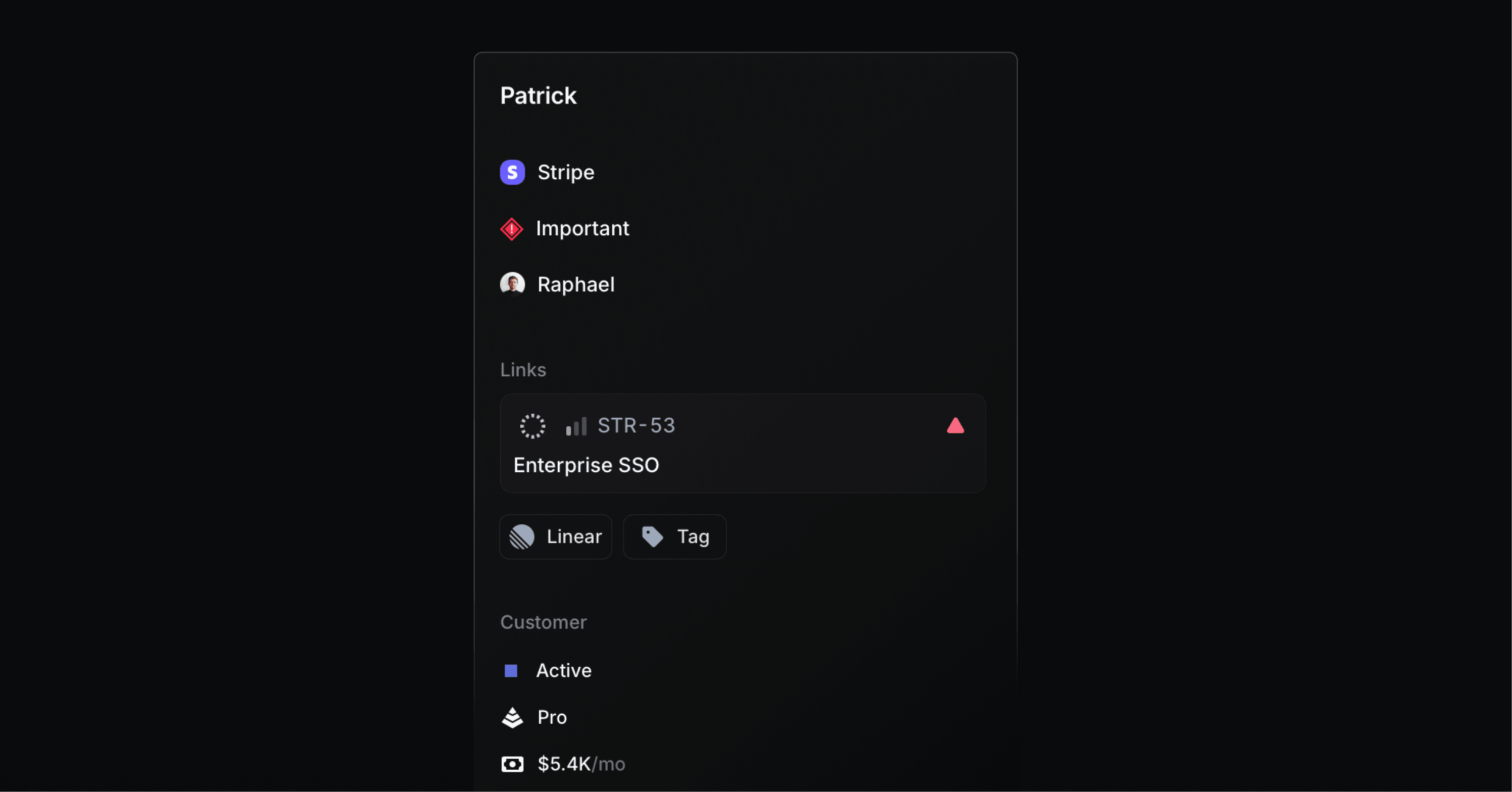
Autonomous support for software companies
The Productlane Agent answers detailed product questions with knowledge from your connected codebase.
Try the agentHow to build a useful feedback workflow
Preserve the customer's original wording and link the request to the account. Group duplicates so the product team can see demand. Keep the evidence behind a priority decision, including the effect on a customer's work.
When the answer already exists in your product, let the agent explain it. When the work requires a change, connect it to an issue and follow up after delivery. Productlane brings those two paths into the same support workflow.
A survey or session-replay tool can still add evidence that customers would not send in a conversation. Choose complementary tools by that missing signal, rather than expecting one support platform to replace every research method.
Questions before you buy
- Where do customers already share feedback?
- Can a teammate find the original conversation behind a request?
- How are duplicates and account context handled?
- Which requests can be resolved through product guidance today?
- Who owns follow-up once an engineering change ships?
Frequently asked questions
Productlane fits teams that want feedback connected to autonomous software support. Canny is a dedicated feedback option, while Featurebase combines support and feedback. Test the request-to-engineering workflow with your own examples.
Those collect different signals. Productlane handles customer conversations and requests. A survey or analytics tool can complement that workflow when you need structured research or behavioral evidence.
A request may expose existing functionality that a customer has not found, or a real product gap. Productlane uses product knowledge to answer the first kind and connects the second to engineering work.
Read the Canny comparison for feedback-board options, or try Productlane.
Perfect autonomous user experiences.
- Autonomous AI support for software companies
- Product knowledge from your connected codebase
- An inbox for the conversations that need your team