AI Support Agent: What Changed and What Good Looks Like

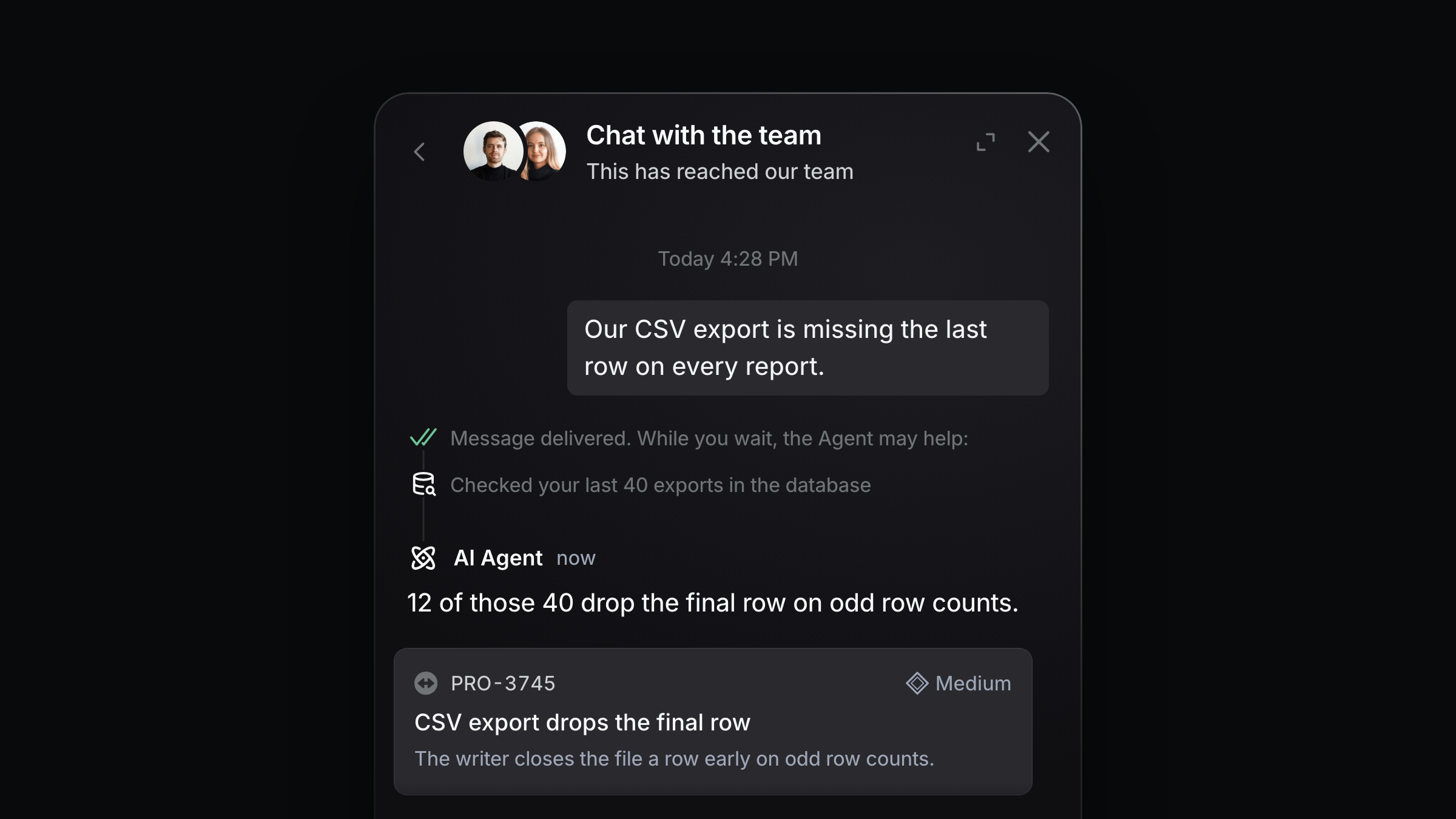
An AI support agent resolves customer questions using the knowledge and tools a company gives it. Productlane focuses on autonomous resolutions for software companies, especially B2B. Its agent learns product behavior from reference articles generated from the connected codebase. This guide explains what to evaluate, how to measure the result, and when a person should take over.
For most of the last decade, telling a customer they were about to talk to a bot was an apology. The bot matched keywords, offered three buttons that were never the right three, and made people type "agent" four times to reach a person. Everyone learned the trick, and support teams learned to hide the bot behind a link.
That changed over the past year. Models got good enough that a well-built support agent reads a messy paragraph, works out what someone actually needs, checks the real state of their account, and answers in a sentence. Customers notice. When the answer is right and arrives in eight seconds, almost nobody asks to be transferred.
The interesting problem moved. It is no longer whether the model can answer. It is whether the product around the model wastes the customer's time. This piece covers what an AI support agent is, what genuinely changed, where agents still lose people, and what to check before you buy one.
What is an AI support agent?
An AI support agent is software that handles a customer conversation end to end. It reads the incoming message, decides what is being asked, pulls the relevant facts from your documentation and your product data, writes a reply, and closes the conversation when the customer is satisfied. When it cannot finish the job, it passes the conversation to a human.
That last clause is what separates an agent from a chatbot. A chatbot follows a script you drew. An agent decides what to do next, including deciding to stop and fetch a person. It can also take actions: look up an order, check a usage record, file a ticket.
What actually changed this year
Three things moved at once, and the combination is what made agents tolerable rather than merely cheaper.
The models got better at saying "I don't know." Earlier generations answered everything with the same confidence, which is how you get an agent inventing a refund policy. Current models can be held to the material you give them, so an honest miss is now the default failure rather than a fabricated answer.
Grounding got cheap. Feeding an agent your whole help center, changelog, and two years of resolved tickets used to be a project. It is now a setup step, which means the agent answers in your product's own vocabulary from day one.
And agents learned to act. Reading a database, opening an issue, and updating a record are ordinary operations now. An agent that can only talk is a worse product than one that can also do the small thing the customer was asking for.
Where agents still lose people
The model is rarely the problem now. Five design choices are, and every one of them is fixable.
| What the customer hits | What it should do instead |
|---|---|
| The loop | The agent rephrases the same non-answer three times because nothing lets it give up. A confidence floor should end the attempt after one miss and fetch a human. |
| The hidden exit | Reaching a person takes a magic word. The handover should be one obvious control, visible from the first message. |
| The repeat | A human takes over and opens with "how can I help?" after the customer already explained everything. The transcript and the account context should travel with the handover. |
| The dead end | The agent confirms a real bug, then nothing happens. A confirmed bug should become a tracked issue automatically. |
| The silence | The fix ships weeks later and the person who reported it is never told. Whoever asked should hear back when it lands. |
Notice that four of the five have nothing to do with answer quality. They are product decisions about what happens at the edges of the conversation, which is exactly where most tools stop paying attention.
The case for an opinionated agent
Most AI support tools ship a builder. You get intent trees, fallback branches, a canvas for drawing flows, and a training phase measured in weeks. The pitch is flexibility. The result is that the agent is only as good as the afternoon someone spent wiring it, and it rots the moment the product changes.
Productlane starts with product knowledge. Your connected GitHub repository can supply reference articles for the agent about the screens and controls customers use. Published help articles and approved knowledge add context. Your team decides what the agent should answer and which connected actions it may perform.
This costs us some configurability, and we think that is the right trade. A team that has to design conversation trees before the agent is useful will put it off, ship a half-configured version, and conclude the category does not work. An agent that is useful on day one gets improved because it is already running.
What a good agent does after it answers
Answering is table stakes. The part that decides whether support gets genuinely cheaper is what the agent does with what it learned.
Autonomous support for software companies
The Productlane Agent answers detailed product questions with knowledge from your connected codebase.
Try the agentIt files the engineering issue itself
When a conversation turns out to be a bug, the agent writes the issue. It scopes the problem, quotes the evidence it gathered, and attaches the customers who are waiting on it. Your engineers get a ticket in the tracker they already live in, written in the shape they expect.
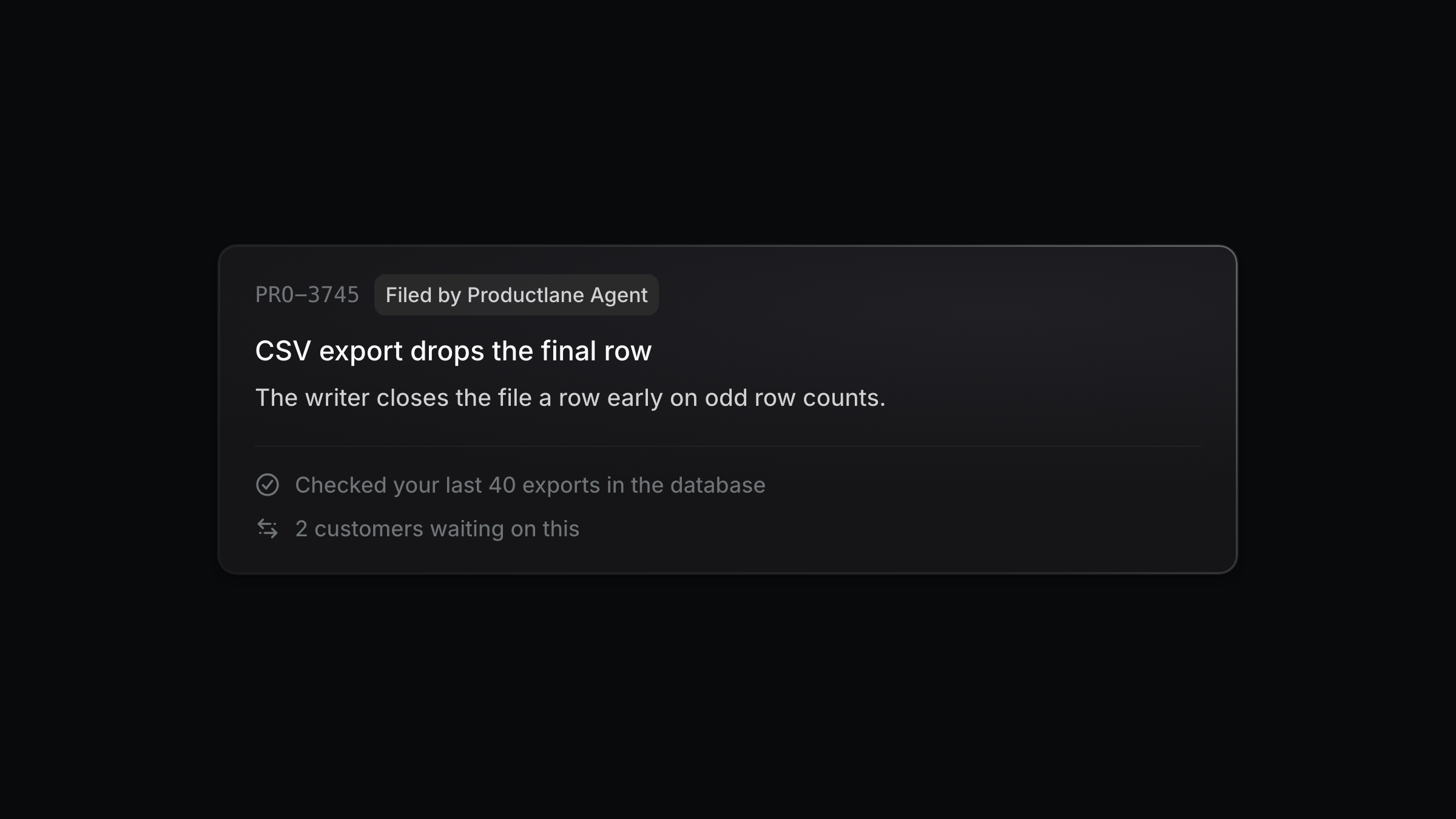
This is the step that turns a support tool into something engineering benefits from. The alternative is a human reading the transcript, retyping it into the issue tracker, and losing the link back to the person who reported it.
It closes the loop when the fix ships
Because the issue carries the conversations that produced it, shipping the fix is enough to notify everyone waiting. Nobody keeps a spreadsheet of who asked for what. The customer who reported the bug in March hears about it the day it lands.
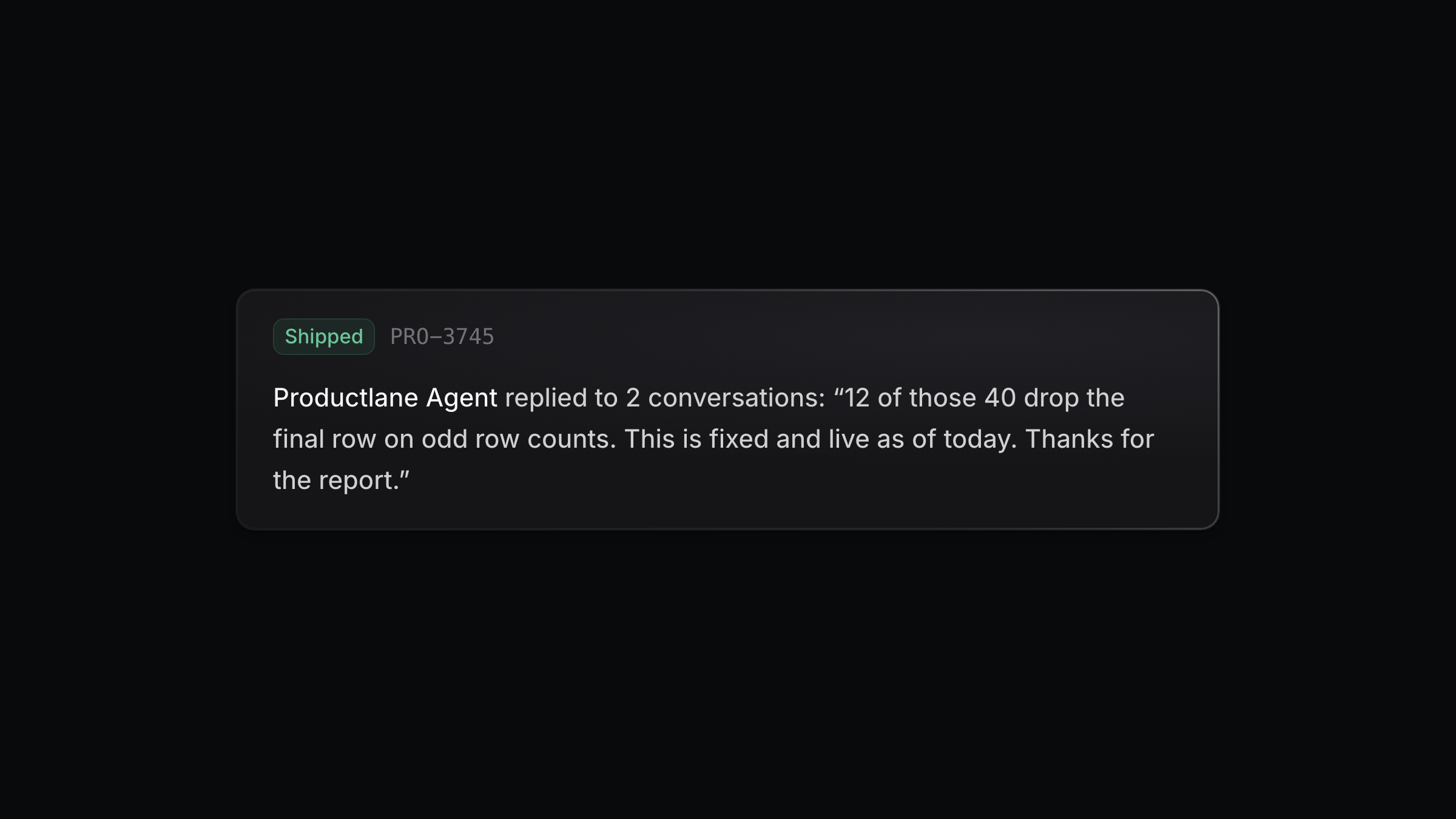
Closing the loop is the highest-leverage message a support team can send, and it is the one that almost never gets sent, because doing it by hand means remembering a conversation from six weeks ago. Automating it is how a bug report becomes a reason someone stays.
It can be judged in one screen
An agent you cannot measure is an agent you cannot trust with more volume. The numbers that matter are few: the share of conversations it resolved on its own, how many it handled, how quickly it replied, and a readable list of the ones it could not answer.
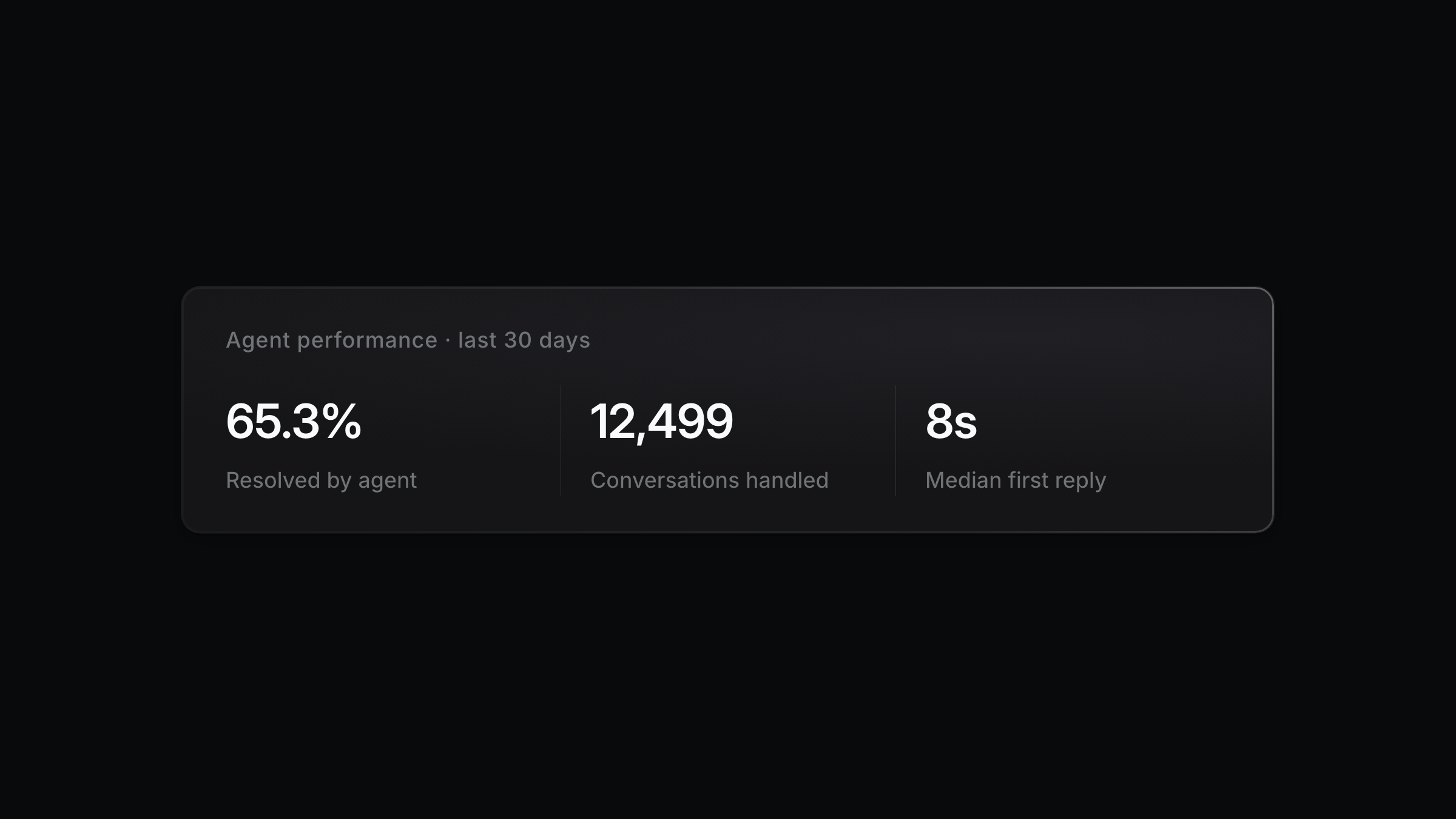
That last list is the useful one. Every question the agent missed is either a gap in your documentation or a genuine product problem, so the failures are a work queue rather than a report card.
Resolution rate, and the number vendors quote instead
Define your metrics before comparing agents. Autonomous resolution should distinguish a completed answer from a conversation that merely ended without a human reply. Report how many conversations the agent attempted as well as how many it resolved.
Review reopened conversations and customer feedback alongside the resolution count. Different vendors use different definitions for outcomes, containment, or deflection. A percentage is comparable only when the denominator and observation period match.
How to evaluate one
| Ask | Why it decides the outcome |
|---|---|
| How long until it answers a real ticket? | Measured in hours, the tool works out of the box. Measured in weeks, you are buying a configuration project. |
| What does it read? | Help center, changelog, past resolved threads, and live product data. An agent grounded only in a FAQ export answers like a FAQ export. |
| What happens on a miss? | Ask to see the handover. The transcript and account context should already be in front of the human who picks it up. |
| What happens after a confirmed bug? | Either it becomes a tracked issue automatically or somebody retypes it. Only one of those survives a busy week. |
| Per seat or per resolution? | Per-resolution pricing lines the vendor's incentive up with yours. Per-seat pricing charges the same whether the agent works or not. |
Where Productlane fits
Productlane focuses on autonomous AI resolutions for software companies. Product knowledge derived from the connected codebase helps the agent answer detailed questions about the software. If a product change is required, Linear supports the engineering escalation and subsequent customer follow-up.
The agent costs $0.79 a resolution, and seats for the humans on the inbox start at $29 each per month on the yearly plan. You can read more about how the whole inbox works in our guide to picking a support tool, or about the ticketing layer underneath it in AI ticketing systems.
Frequently asked questions
An AI customer support agent is software that handles a customer conversation from the first message to resolution. It reads what the customer wrote, works out the intent, pulls facts from your help center and product data, replies, and either closes the conversation or hands it to a human with the context attached. Unlike a chatbot, which follows a script someone drew in advance, an agent decides what to do next and can take actions such as checking a record or filing a ticket.
In practice you buy the agent and supply the material. The work is getting your help center current, connecting the product data the agent is allowed to read, setting the confidence floor at which it hands over, and deciding what happens when it confirms a bug. Tools that need intent trees and conversation flows drawn by hand add weeks to that and start rotting as soon as the product changes.
A customer writes that their CSV export is missing the last row. The agent checks their last 40 exports, finds that 12 dropped the final row on odd row counts, and tells them what it found. It files a scoped issue for engineering with that evidence attached, links the customers waiting on it, and messages them the day the fix ships. That full sequence is the screenshot at the top of this page.
Four ways, roughly in order of how much they save. Resolving repetitive questions end to end. Drafting replies for humans on the harder ones. Turning confirmed bugs into tracked engineering issues. And closing the loop with everyone who reported a problem once it ships. The first is the one vendors sell. The last three are where the compounding value sits.
The useful rate is the one measured on your own support workload. Match the ticket mix, knowledge access, and resolution definition across agents. Our historical measurement is described above; it should not be treated as a guaranteed result for another company.
They are annoyed by specific things rather than by AI itself: an agent that loops, hides the way to a human, makes them repeat themselves after a handover, or confirms a problem and then goes quiet. Fix those four and acceptance is high, because the agent answers correctly in seconds at three in the morning. Customers care about being helped, not about who helped them.
Autonomous resolutions for software companies
Productlane focuses on resolving software support questions autonomously, with a particular focus on B2B. The Productlane Agent learns how your product works from your connected codebase. That gives it product knowledge for questions about settings, permissions, or behavior that a short help article may leave unanswered.
Product knowledge from your codebase
Through the GitHub connection, Productlane reads the repository you select to create reference articles for the agent. These describe the product your customers use. They stay outside the public help center, while articles marked internal remain excluded from the customer agent's knowledge. The agent uses this product knowledge to explain what a customer should do.
Your team controls what knowledge the agent can use. Review generated articles before relying on them for sensitive workflows. Connecting a repository supplies product context; it does not give customers repository access.
Measure completed resolutions
Evaluate the agent on your own software questions, with one resolution definition, your real ticket mix, and a fixed observation period.
When a question needs an engineering change, the agent can file a Linear issue with the conversation attached. Productlane prepares a customer follow-up when the linked work ships. That engineering workflow supports the main goal: more customer questions resolved autonomously.
See the Productlane Agent or how to evaluate an AI support agent.
Perfect autonomous user experiences.
- Autonomous AI support for software companies
- Product knowledge from your connected codebase
- An inbox for the conversations that need your team